Revolut custom card design
What is Revolut?
Revolut is a British fintech company, often called a neobank (a digital-only bank), founded in 2015 in London. It provides financial services through its mobile app rather than physical branches. Revolut offers a range of services including:
Multi-currency accounts: Hold and exchange money in multiple currencies with competitive rates.
International money transfers: Send money abroad quickly and often cheaper than traditional banks.
Cryptocurrency trading: Buy, hold, and sell cryptocurrencies like Bitcoin and Ethereum.
Budgeting tools: Manage spending and savings with built-in app features.
Premium accounts: Paid plans offer extra benefits like travel insurance.
Stock trading: Invest in stocks directly from the app.
Disposable virtual cards: Use virtual cards for secure online purchases.
Custom card designs let you personalize your Revolut card with colors, patterns, or your own images. It’s a simple way to make your card unique and reflect your style.
Technical Implementation
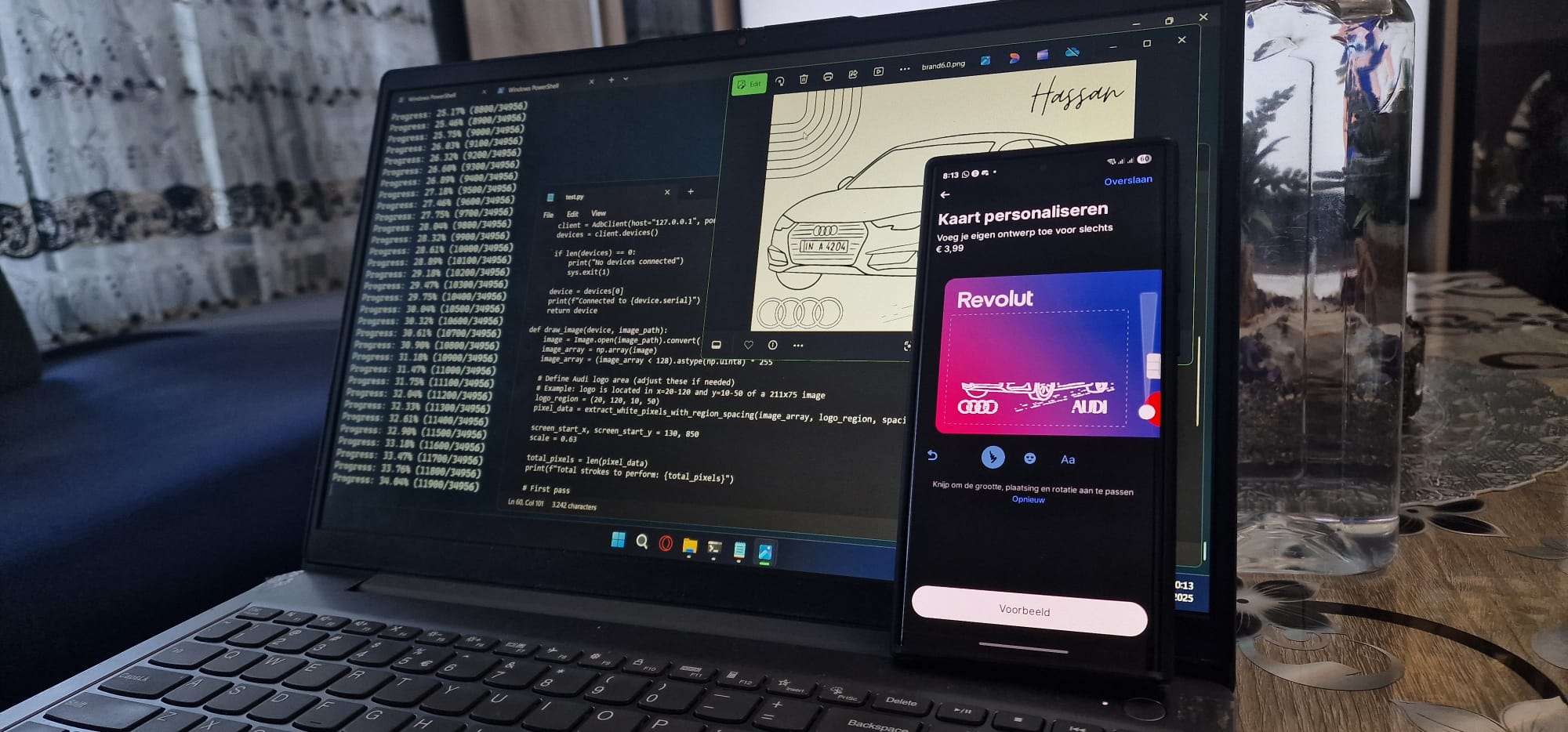
This project was not just about design—it was a technical automation challenge. I created a Python script that converts an image into pixels and automates the process of applying a custom card design to a Revolut account.
Technology Stack & Process
The automation workflow involves:
- Python Image Processing: Created a script that converts custom images to pixel data for processing
- ADB Integration: Used Android Debug Bridge (ADB) to communicate with the phone and automate clicks
- Mobile Automation: The script automatically navigates through the Revolut app and applies the card design
- Click Automation: Programmed precise touch inputs to replicate user interactions on the phone screen
- Efficient Workflow: Eliminates manual repetition by automating the entire card customization process
Why This Project Matters
This project demonstrates advanced skills in:
- Python Programming: Image processing, scripting, and automation
- Mobile Automation: Working with ADB and Android systems
- Problem Solving: Finding creative technical solutions to simplify workflows
- Integration: Combining multiple technologies to create a seamless automation pipeline
It's a great example of how programming can be used to automate repetitive tasks and improve efficiency in real-world applications.
Project information
- Category Hobby Project
- Client Hassan Arab
- Project date January 2026